Are We Completely Wiping That Hard Disk?

Authors: Guest Writer

Guest Post by Micah Lahren:
"I’ll just run DBAN on it and that will be good enough."
Is that really good enough? What if the individual or business in question is required by law to complete an erasure protocol up to a certain level of security? In some countries, including the United States, laws requiring secure erasure of data are also accompanied with a punishment if the protocol is not followed, such as fines of $250,000 and 10 years imprisonment.

Is your client’s company disposing of old hardware, or do you have a client with sensitive data who desires complete and total erasure of data? Jackhammers, wrenches, and explosives may be more enjoyable methods of destruction, but what if the user would like to use the old hardware for non-sensitive data in another way, such as an external hard drive for storing personal data of a non-sensitive nature? DBAN it, right?

Why DBAN Isn’t Enough

On the official dban.org website, DBAN is heralded as a “self-contained boot disk designed for consumer use”. The key word in that statement is ‘consumer’. DBAN and similar software intended for wiping hard disks are known as software based overwrites, or ‘clear level processes’, and are vulnerable to recovery without requiring laboratory methods. For instance, if you know what the HPA is (Host Protected Area), you’ll know DBAN doesn’t wipe it. Why should we worry about the HPA?

The HPA can be used by rootkits to hide from Anti-Virus software, manifesting again upon a reinstall of an operating system. The HPA is also used by some vendors to store data relative to the installations of software. One security firm is known to use the HPA to load software that reports back to their servers when the machine is connected to the internet. An employee could use the HPA to store data which would be hidden from many wiping tools, and recover that data later after the drive had been supposedly ‘wiped’ of all data and considered free to use in other applications.

In view of the above currently known uses, including the looming recent threat of cyberwarfare, this alone could present a high security risk for many companies and government entities. Many erasure tools do not touch the HPA or other hidden areas of the drive, which are inaccessible to many wiping tools. How can we effectively eliminate all data on the hard disk without physically destroying it?

Secure Erase

Secure Erase (SE) is a feature built into all ATA drives with 15 GB or greater capacity manufactured after 2001. There is also a Secure Erase command for SCSI drives as well, but you may not find it on all drives, as it is an optional feature. Basically, executing a SE command will virtually shred all electronic data on the hard disk in question. It will completely wipe the HPA and other hidden partitions on disk drives, which means any area of the drive which is available for hiding data will be completely wiped, beyond known forensic recovery.

SE will also wipe sectors that are unused by the drive due to errors. It performs a single pass, and that one single pass is more than enough, as technical testing confirmed that multiple passes were unneeded as far as additional erasing was concerned. This single pass meets U.S. Requirements for secure erasure of data for the regulations concerned, with the exception of highly sensitive data which requires complete physical destruction of the disks. Unless you’ve got top secret government files on your hard disk, SE should fit the bill for most clients.

A Freeware Tool That Implements Secure Erase?

That’s right, it’s completely free. And while the NSA has unfortunately dropped support of this great tool, it’s still available. It also utilizes something called Enhanced Secure Erase technology, which the FAQ for this utility details: Enhanced secure erase writes predetermined data patterns (set by the manufacturer) to all user data areas, including sectors that are no longer in use due to reallocation. It’s called HDDerase, and can be found here: http://cmrr.ucsd.edu/people/Hughes/SecureErase.shtml

Due credit goes to G. Hughes of UCSD CMRR for this utility. I won’t go into the details of all the technical aspects of the utility, but there’s a data sheet referenced on the web site you can read that goes into deep detail on the methods used.

Basically, HDDerase is a DOS-based utility for ATA hard disks. You can boot it with an antique 3.5 disk, or boot it from a CD. The last time I checked, HDDerase is also available on the Ultimate Boot CD, and is probably on a few other less known boot cd’s along with other tools useful to techs. It can also be booted from a USB flash drive as well. This utility can also bypass the ‘security freeze lock’ which the BIOS sometimes executes when it detects the drive.

Make sure you use version 3.1 or later, as these versions allow you to remove the HPA as well as the DCO on the disk. While this tool cannot be guaranteed to work on absolutely every hard disk in the field, it has worked on every hard disk I’ve had thrown at me for erasure. Scan the readme file provided on the official site before running the utility, just to be sure you cover all your bases. Simply boot it up, follow the prompts, and you’ll have a forensically clean hard disk that is beyond recovery as far as data is concerned, and still have a usuable disk for other applications.

Guest Post by Micah Lahren – Micah covers a wide spectrum of the tech industry, including PC repair, front-end development, WIMAX networking and installation, and more. He currently works with an ISP in Texas that also provides web hosting/design and computer repair, although he’s been tinkering with computers since he was 6 and eventually turned it into a career. He also enjoys traveling and doing volunteer missions in other countries.

© Technibble – A Resource for Computer Technicians to start or improve their Computer Business
To get started with your own computer business, check out our Computer Business Kit.
image

Read more:

WiseTechnician Review

Authors: Bryce Whitty

Does up-selling to your clients make you feel like a used car salesman? Most Computer Technicians come from a technical background so sales and marketing does not come naturally. Now that you are in business, sales is really something that you cannot avoid if you want to make money. I had heard about these WiseTechnician videos mentioned a few times in my Computer Technician circles that focused on the sales side of the Computer Repair business, and I wanted to check it out not only for myself, but for all of Technibbles readers to see if they are worth purchasing. This is my WiseTechnician review.

So What Is it?

The WiseTechnician videos are a collection of videos about the business and marketing side of the computer repair business. The package includes 26 High Quality 480p videos resulting in 3.5 hours of content. There are also audio-only versions of each of the videos so you can listen to them on the go.

The package includes videos on a variety of topics such as what to ask the customer, stocking inventory and selling it, finding a wholesaler, parts and pricing, billing and accounting, working in small/depressed areas, managed services, getting business customers and more.

Under The Hood

The videos are done in an interview style over Skype with Steve Cherubino from Podnutz as the host. The videos are broken up into 26 different topics and each video ranges from 5 to 10 minutes in length making them 3.5 hours in total.

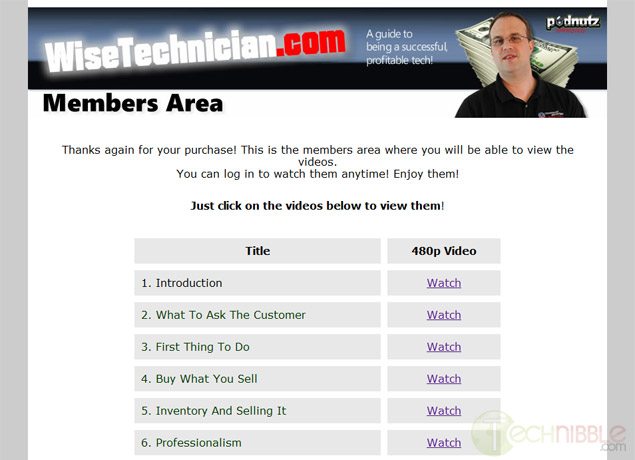
Once you pay for the product via Paypal, you will be sent an email with login details to access the members only area on the WiseTechnician website which allows you to access the videos from any computer and mobile device capable of playing .mp4 files. Having the product stored like this is handy if you lose the videos because you can just login and download them again.


So What Are The Videos Like?

The videos are high quality Skype video calls and both Steve Cherubino and Chris Barre having good microphones and webcams. While the total length of the videos is only 3.5 hours long, there is little fluff in these videos and they are full of “gold nuggets” of information. In fact, while I was watching these videos there were many times where I thought “That tip alone is worth the cost of these videos”.
The videos are like watching one giant Podnutz interview and Chris can quite animated. He really is a no nonsense kind of guy.


A lot of technicians talk about ideas that they are going to try which may or may not work. I found the videos useful because they say “Do this, it works. Here is how to say it”.

I have only two gripes with this product. First, there are a couple of points audio drops out, but only for a split second. I guess thats is the the nature of Skype.
Second, I am not a fan of the site design as it looks too infomercial-like. However, the product itself is no-fuss, solid content.

So Who is Chris Barre?

Chris (the “Wise Technician”) has been doing computer repair for the last 7 years and has been sales for 14 years in both retail and business to business.
He used to own an an applicance repair company which had a store front and as well as doing onsite applicance repair. That business is still going strong and had 5 employees when he sold it.
Chris wanted to make a product that helped Computer Technicians make some serious money and get over the “computer guy shyness”. He has been talking to Computer Technicians for the past 3 years on the Podnutz network and their issues always came down to them not charging enough, feeling bad for making “too much” profit on a product, and not being able to sell new services and products to their existing customers.

Who Is This Product Not For?

If you have been running your business for many many years (Say, 5 years plus) then you are going to get less out of it. That is not to say you wont get anything out of it as the videos are a combination of startup tips and sales tips. I myself have been in business for about 10 years and I still got sales tips out of it that would make it worth the cost. If you still dont feel comfortable with sales then you will find the product useful.

The videos are not for you if you dont plan to invest the time to actually watch/listen to the videos and impliment the tips. This is not a get-rich-quick plan.

Who Is This Product For?

If you are within the first few years of your business, you will get a lot of great tips from these videos. As mentioned above it covers both startup tips (such as how to find a supplier) as well as sales tips. I know most new computer business owners dont feel comfortable about sales since they came from a more technical background. They often feel like a sleezy car salesman when trying to sell. Chris gives you some really elegant ways to sell to your clients without feeling like a scumbag.

The product retails for $79.95 and comes with a 60 day money back guarantee. There is really is no reason not to give them a try as it is risk free.

Check out the WiseTechnician Videos Here


© Technibble – A Resource for Computer Technicians to start or improve their Computer Business
To get started with your own computer business, check out our Computer Business Kit.
image

Read more:

YUMI – Install Multiple Operating Systems to a Single Bootable USB Drive

Authors: Bryce Whitty

YUMI (which stands for Your Universal Multiboot Installer) is a tool that allows you to install multiple operating systems to a single bootable flash drive. YUMI will automatically create a menu allowing you to choose which operating system you wish to boot into as the system starts. We have featured mutliboot creators in the past but I really like YUMI because it is just so easy to use.

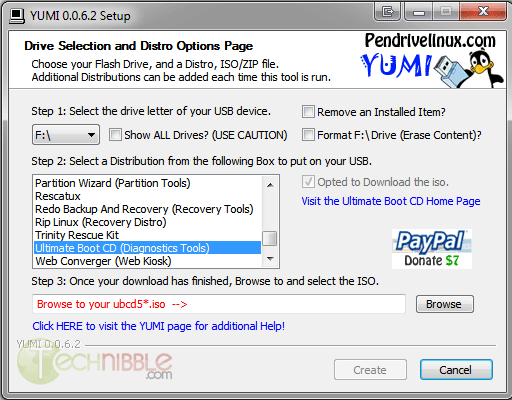
To use YUMI, you simply choose the drive letter of the thumb drive you wish to use, select a distribution you wish to install from the list, tick the “Download the ISO” if you havent done so already, wait for the ISO to download, navigate to the download location of the ISO on your hard drive and press Create. Thats it. To add an additional ISO to the USB drive, just do the steps above again.

Even though the boot menu and the ISOs installed on the USB drive are Linux based, you can still use the same drive to carry your Windows based repair tools since it formats the thumb drive to FAT32 – which is readable by Windows. However, I suggest you don’t move any of the files YUMI placed since it may upset the software installed on it.

Another reason I like this software, especially for us Computer Technicians is the selection of ISOs you can install on it. As you would expect, the usual suspects like Linux Ubuntu, Mint and Puppy are included. However, YUMI features a lot of distributions specifically intended for computer repair such as:

  • Acronis Antimalware CD
  • AVG Rescue CD
  • AVIRA AntiVir Rescue CD
  • BitDefender Rescue Disk
  • Dr. Web Live CD
  • F-secure Rescue CD
  • Kaspersky Rescue Disk
  • Panda SafeCD
  • Blackbox (penetration testing)
  • BackTrack5 Blackbox (penetration testing)
  • Clonezilla (Backup + Clone Tool)
  • DBAN (Hard Drive Nuker)
  • Deft 7 (Forensics)
  • DRBL (Diskless Remote Boot in Linux)
  • EASEUS Disk Copy (Disk Cloning Tool)
  • GParted (Partition Tool)
  • HDT (Hardware Detection Tool)
  • Matriux (penetration testing)
  • Offline NT Password & Registry Editor
  • Ophcrack XP (Password Finder)
  • Ophcrack Vista/7 (Password Finder)
  • Parted Magic (Partition Tool)
  • PING (Partimg Is Not Ghost)
  • Partition Wizard (Partition Tool)
  • Redo Backup and Recover (Recovery Tool)
  • RIP Linux (Recovery Distro)
  • Trinity Rescue Kit
  • Hirens Boot CD
  • Kon-Boot Floppy Image
  • Windows Vista/7/8 Installer

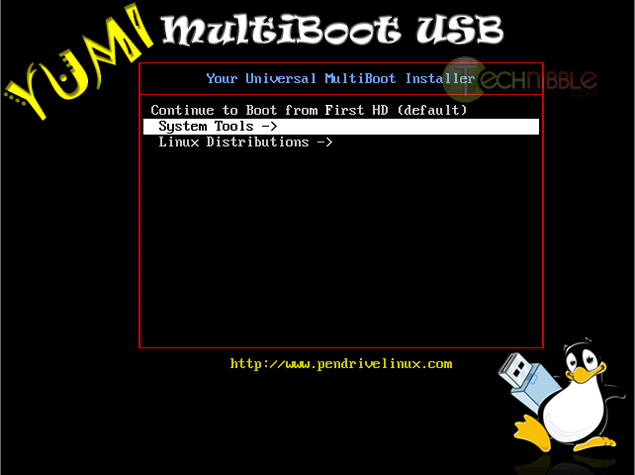
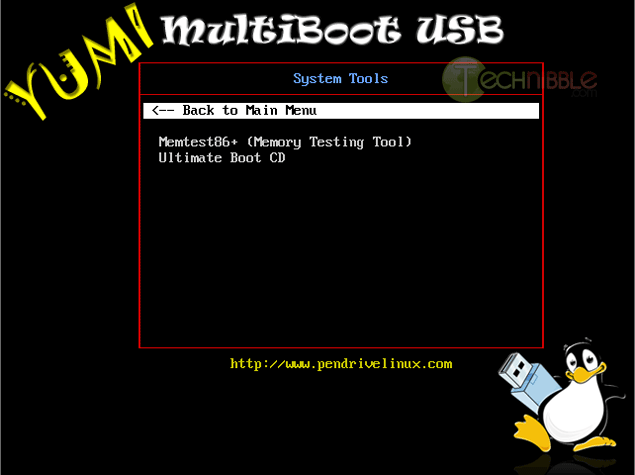
If you happen to install multiple operating systems to your USB key, YUMI will categorize them as you can see in the screenshots.

Screenshots

YUMI - Multiboot USB Interface

YUMI - Multiboot USB Bootloader

YUMI - Multiboot USB Bootloader


Downloads:

Download from Official Site – 948kb

More Information

© Technibble – A Resource for Computer Technicians to start or improve their Computer Business
To get started with your own computer business, check out our Computer Business Kit.
image

Read more:

How to Increase Your Business Clients to Improve Your Profit Margins

Authors: Guest Writer

Guest Post by Richard Muscat Azzopardi
Taking the step from being a computer technician fixing home PCs to someone running a business which thrives off planning, building, maintaining and repairing other businesses’ IT solutions is one which might seem daunting to some. However by doing so you can increase profit margins considerably and probably reduce your general stress levels in the process too.

Before you ponder on changing your business model, however I would advise taking a long hard look at the business you’re running at the moment. Have you ever thought of whether it is really profitable? If you were paying yourself (and your better half, who’s probably putting in quite a bit of hours with you) an honest wage would you still be running a profitable business? When was the last time you ran this exercise?

As part of this check I would also recommend analyzing the different jobs you’re doing. Which of them are profitable and which of them are you doing as a “service” to your clients? For example some home clients expect you to do the installation work for free when you sell them hardware. Even if you are charging them, there is a limit to what you can charge unless you want them to run to the Internet to look for advice and try it out themselves.

Business customers are very different. First of all they see IT as an essential tool. There might have been a time when a farmer would try and fix his own truck, but nowadays they all take them to mechanics. The same goes for computers – businesses see them as something they can’t live without (because they really can’t!) and therefore tend to do whatever is needed to keep their systems running smoothly. A home computer not working for a day means you can’t check Facebook for 24 hours. A business computer not working for a day implies loss of productivity and therefore precious income.

Because IT is so important to businesses, they tend to generate a significant amount of work. A successful business must take its maintenance seriously, its upgrades with enough foresight and its backups with the precision of a Swiss watch! In addition to generating more work per computer, when you’re hooked up with a business client, you usually have more PCs to work on too. If you take a look at the turnover generated by a single (small) business client over the course of a year you can probably equate it to four to five families’ worth of work.

It is not all fun and games, because expectations on your level of commitment increase too, but this is mainly the reason you can charge higher rates. It is also harder to win the client over because there is more competition and a higher chance that they are already in some form of a relationship with another supplier/technician.

If you have decided that it is worth exploring as an idea, you now need to find ways to get the word out there and start attracting business clients. I have a few suggestions that you might want to try out.

1) Tap your existing client base

Your existing clients are probably an ideal first step in trying to get new business. Statistically, most of them work at a small business, so if you approached them there is a good chance of them either being the decision maker at office or at least knowing who is. Don’t push yourself too hard with people who are generating your bread and butter income though, because you don’t want to scare them off from giving you their custom. You can either drop a hint when you’re at their place or else insert a new email signature which says you service businesses too. It might also be worth your while to offer a small bounty to friends and long-term clients who can introduce you to a new business client.

2) Approach the local business community

Targeting local businesses with direct mail, the local yellow pages or advertising in a local paper would be a great method to start offering services. Your major investment here could be your time. Offer a free audit of their systems – that way you can give them something of value. If you do your job well enough at this stage, you’re the one they’re going to want to implement the recommendations to fix the issues that arise.

3) Mixing at business events

Scour the papers and online notice boards for business breakfasts or any other business meetings organised in your community. These are a great source of new contacts and people are expecting you to discuss business opportunities. If there are talks, then try and get a speaking gig – even if you offer your time for free. Use this time to outline the importance of having a solid IT infrastructure. Businesses love having a thought leader consulting them – it inflates their ego.

4) Buy a set of golf clubs

Or join the local chapter of the Rotary Club. Every community has its own version of a place for businessmen to hang out informally. Whereas these might seem to be a place to relax, a lot of business wheeling and dealing goes on in between holes on the local golf course. You will have to take it more easily here. People are officially there to enjoy themselves and relax so you have to observe others and respect the etiquette in place.

5) Online

Building a good presence online is a crucial part of achieving your goal. I have left it to last for one simple reason – no matter which of the methods above you decide to go with, this should have to happen in tandem. Create a personal LinkedIn profile and build it up as much as possible. Get recommendations from former colleagues and current clients and keep the account active on a daily basis. Create Google+ and Facebook pages as a local business and post items to them regularly. Ideally you shouldn’t broadcast, but also interact with people who’ve liked your pages. Offer free advice online to business customers – and make these posts public so you can show your expertise.

Whichever of these tickles your fancy, I would suggest not trying out more than one or two of them to start off. Ease yourself into the market and there is far less chance of being overwhelmed. Slow and steady wins the race.

This is a guest post written by Richard Muscat Azzopardi on behalf of IT Channel Insight, a site related to managed IT services. Richard draws on his experience from over 12 years in the publishing industry to bring you top quality content that works. He now writes blog posts, white papers and e-books for the IT industry with the same passion that drove him to create his country’s most popular publication.

© Technibble – A Resource for Computer Technicians to start or improve their Computer Business
To get started with your own computer business, check out our Computer Business Kit.
image

Read more:

How to Effectively Charge Customers for Travel Time

Authors: Derrick Wlodarz

Tackling any topic related to rates is likely one of the most debatable areas to touch with a ten foot pole. Technicians are stoutly protective of their pricing structures when the discussion comes up. However, I’m admittedly adventurous in this realm and believe that the more open we are with effective ways to address travel costs, the better we can serve our customers in settings fees that are appropriate for both sides. I took a chance to address proper self-worth valuation when it comes to pricing a little while back, but let’s see if we can tackle travel costs this time around.

My goal here is not to say that my methodology is necessarily better; it works for my computer repair company FireLogic and I’m open to sharing it fully with fellow techs. The overarching goal with this article is to merely establish a friendly debate on all of the available methods for charging on travel, and weighing the pros/cons of each. There is no single method or rate that fits all technicians. We’re all disparate in our own ways: serving different communities, working with different customers, and operating within distinct socioeconomic regions.

The Technibble forums are generally host to some interesting discussion on travel fees and how to determine them. A few particular threads hosted some great insight like this one, a thread related to call out charges, and this discussion on how to charge for visits that are out of area. I’m going to admittedly pull a mixture of ideas from various forum postings below to give people an idea of what various techs have concocted to meet this growing need. Let’s take a look at the different ways you can charge your own customers for travel time.

The flat hourly rate

I’ll cover this one first since this is how FireLogic handles travel costs. I like this model because it’s simple for a customer to understand and doesn’t require any extensive tracking/recording besides time. My view is that if someone is willing to pay for us to travel out to visit them, a flat hourly travel rate properly compensates the tech that needs to make the trip and covers gas expenses. Our travel rate is currently $20USD/hr (about 1/4 of what our hourly onsite rate is) and has proven to be a happy medium for our customers and techs. We do not charge for return travel, as the notion goes that the next customer being visited will pick up the subsequent trip as their visit charge. Some forum goers admit to charging their full hourly rate for travel, which is understandable depending on your situation. Do your research before establishing anything, but for the Park Ridge and suburban Chicago area (USA) this system has been very successful for us with little customer pushback.

Enforcing minimum onsite service fees

This is an roundabout to charging outright travel fees or an hourly trip rate. In this method, you notify your customer that they will be paying, for example, a one hour minimum of service for the visit. More than a few techs on the forums prefer this approach as it keeps travel fees out of the customer’s sight, and also cuts back on excessive abuse of onsite labor for small tasks. From the consensus I could gather, it seems that rural techs tend to like this method as travel fees are frowned upon in such locales but customers take positively to this approach. I don’t think it would be a bad idea to use a hybrid approach of a travel rate with an onsite minimum. Again, your circumstances and competition’s methods will have a big bearing on your own attitude towards this model.

Staggered travel flat-rate fee

Yet another way to charge for travel is to create a graduated, or staggered, trip charge schedule that is based upon the number of miles from your home base to the customer location. The benefit of this model is that it directly segregates shorter trips from longer ones, and gives the customer an easy way to estimate their final total. However, the downside is that if traffic catches a technician, even a short 4 mile trip in an urban area could turn out to take just as much, if not more time, than a 10 mile journey in the countryside. I personally frown upon this model since I service the suburban Park Ridge region of Chicago, and traffic can be dicey depending on time of day and the direction of a customer location. For rural techs, this may be more appealing.

Charging “by the mile” based on a standard rate

A similar method as the staggered model above, but this one ties exact mileage or distance traveled to a standardized rate “per mile” or “per kilometer.” For the United States, I have heard of many techs tie their rate to correlate directly with the mileage rate used by the federal government. As with the staggered method, I don’t believe it fully takes into account the time spent traveling to a customer in busy, traffic-drenched areas. But for techs that want a simpler, streamlined way to present their travel rates to customers, this is about as clean cut as it gets. Tying your travel rate to the same as the government uses cuts down on arguments from clients because you can merely point them to the higher authority for why you charge what you do.

Utilizing different onsite vs offsite service rates

My company uses this notion for how our prices are set. For our case, it’s not directly to take into account travel costs. We differentiate hourly rates moreso because of the simple fact that when I am onsite, I am dedicated solely to that single customer. I cannot multi-task in any way like one can do in-shop or from their home office. For this reason, a different price is justified. But some techs claim that merely forgoing a separate travel fee and charging an inflated 20-30% of their regular rate is effective. The benefit is that you can mask your travel costs to the customer. The downside is that such a massive difference in rate may sway more customers than you wish to use your services at the “discounted” rate and stick to remote support or the like. Good or bad, it’s up to you to decide how this may work out.

Whichever method you ultimately decide to use, remember that doing some competitive analysis is always key to a rate structure that customers will be open to. You don’t want to blindly change your travel fee methodology without sniffing around to see what your local techs are charging, and how they are structuring their fees. Systems that may work well for rural areas are not always suitable for urban areas as I described above. Do your homework, reach out to some customers for their feelings, and make an informed decision. How you publicly account for travel expenses using any of the methods above may be just as important as what amount you charge a customer.

Feel free to post your own ideas or comments on what you think is the best way to charge for travel. What works? What doesn’t? Let us know!

© Technibble – A Resource for Computer Technicians to start or improve their Computer Business
To get started with your own computer business, check out our Computer Business Kit.

image

Read more:

How To Create Effective Craigslist Ads For Your Computer Repair Business

Authors: Bryce Whitty

Unless you have been living under a rock for the past few years, you have surely heard of Craigslist.org. If you haven’t, Craigslist is a network of online communities featuring free online classified advertisements. It allows you to post advertisements offering your computer repair services and essentially gain clients for free.

Some Computer Technicians love Craigslist and say that they have acquired their best clients from there while others wont go anywhere near it. It definitely has a bad reputation thanks to the $5 per hour technicians that advertise there but dont let that deter you as it can definitely help your business.

In this article, I’ll show you how to form an effective Craigslist ad and keep it visible.

Money vs Effort

Before we go any further, while posting on Craigslist is free (and who doesnt like free advertising right?), it does take time. Whether it is worth it or not will depend on your situation.
If you have time but not much money, Craigslist can be a fantastic source of clients. If you stay pretty busy with your existing clients then it may not be worth it. If you are just starting your business then you definitely shouldnt pass up the opportunity to gain some initial clients.

If you live in other countries where Craigslist isnt as popular like the UK or Australia, you can substitute Craigslist.org with Gumtree.co.uk or Gumtree.com.au

Creating Your Ad

The key to creating a great ad is to make it to be able to be read quickly and be keyword rich but still human readable. You might consider something like this:

*** YourTown Computer Repair ***
Honest, Secure and Reliable
Over X Years of Experience
Reasonable Rates
Services Include: Virus Removal, Desktop & Laptops, Hardware & Software Repair, Networking
Call XXX XXX-XXXX
Your Name

This is an effective ad because it can be scanned by the reader. You need to get your point across quickly as the customer may be looking at 10 other ads and they often they will not bother to read huge blocks of text.
While this ad is very short, it says a lot more than what was actually written. Let me break it down line by line so you understand why these words were chosen allowing you to create your own ad.

  • *** YouTown Computer Repair *** – When a future client is scanning a page of Craigslist advertisements but they are looking for a few keywords. They will be looking for Computer Repair services that is in their area. By having a heading like this, ticks all boxes in their mind and quickly gets their attention. Also, having a few special characters around the text seems to get more attention, but dont overdo it.
  • Honest, Secure and Reliable – As most people know, there are some seriously shady people on Craigslist. These words acknowledge that there are some bad operators on Craigslist and helps set you apart that you are not one of them.
  • Over X Years of Experience – This one is pretty obvious. If you have many years experience then it is worth mentioning to help separate you from the other ads. Of course, if you only have minimal experience then dont mention this line
  • Reasonable Rates – You may have noticed that I havent posted the price anywhere in the ad and have only said Reasonable Rates. The reason for this is that if the customer is shopping solely on price, you will usually lose out to the $15 per hour Computer Technician. However, not everyone is shopping based on price and would rather pay a premium for someone who is good, honest and reliable. These are the clients you want. Also, by not posting your rates it requires the customer to call you and this is your chance to sell. Understand your client, sympathize with their problem and offer to make it right:
    “Your computer wont start up and you have a school project to hand in tommorow? Oh, thats not good. We can have a tech out there today and we’ll do what we can to get your machine and running as soon as possible”.

    Keep in mind that the client will also be judging you based on your phone call. You can tell a lot about someone with only 30 seconds on the phone.
    Do you answer with “X Computer Services. How may I help you?” or with a sleepy “Hello?”
    Do you sound educated or speak in slang?
    Answering the phone like a professional will help separate you from the technicians who are only doing work for pizza money.

  • Services Include X, X and X – We are doing this so that people know the services that you offer, but also works as keywords for the Craigslist search feature. “Virus Removal” has been listed as the first service because most clients always think their problems are virus related, regardless of what the issue actually is.
  • Your Name – Signing it off with your first name makes it seem a bit more personal and that they are not dealing with a faceless corporation

Keep Posting

Depending on your location, the Craigslist listings can move fast. You could post your ad at 9am in the morning and it could be be pushed off the bottom of the page by 10am. The way to stay at the top of the page is to post your ad multiple times throughout the day. Having said that, Craigslist frowns upon duplicate postings so in order to post your ad multiple times a day you need to change the ad slightly. You can do this by moving the lines around, maybe even test out a few completely different ads to see which one is the most effective.

If you post your ad to the Craigslist pages of large cities, your ad may drop off the page too fast. Consider posting to the Craiglist pages of the smaller surrounding towns.

If your ad is still getting pushed off the page quickly, there are more extreme methods such as posting from a handful of different Craigslist accounts with each of them posting a few times a day.

© Technibble – A Resource for Computer Technicians to start or improve their Computer Business
To get started with your own computer business, check out our Computer Business Kit.
image

Read more:

Mobility Changing IT Field Services

Authors: Diana

Guest Blog: Scott Epple, OnForce Product Manager We’re living in pretty exciting times.  Most of us carry around small computers with us everywhere we go.  The same computing power that used to take up the size of a large room, now fits handily in our pockets.  Smartphones are connecting us to the people and places […]

Read more:

GSmartControl – Monitor and Test Hard Drive SMART Data

Authors: Bryce Whitty

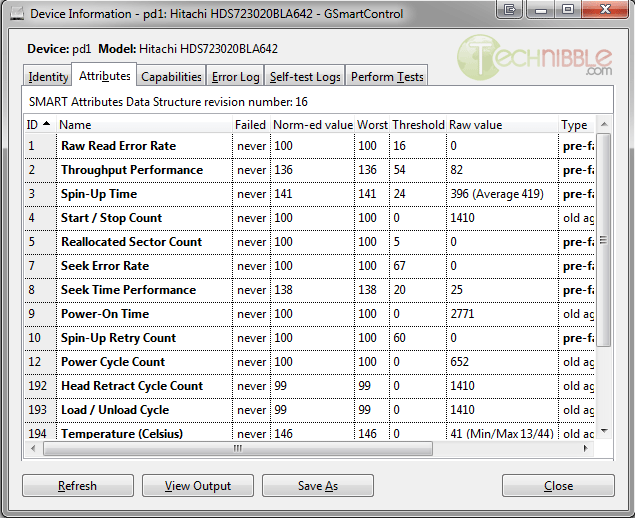
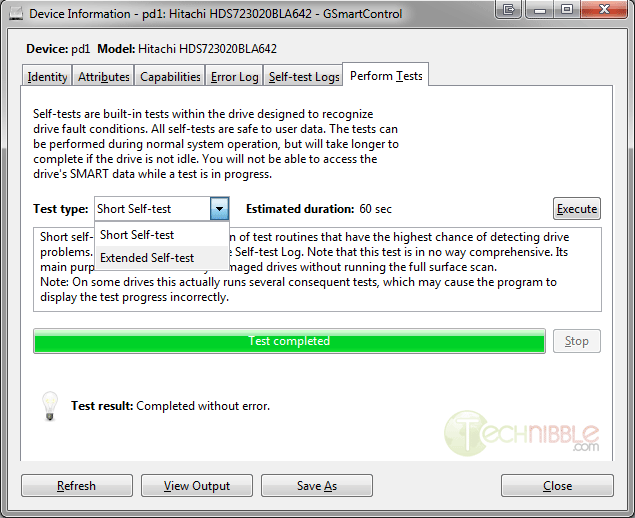
GSmartControl is an open source and portable application for identifying, monitoring and testing hard drives. GSmartControl differs from applications like CrystalDiskInfo because GSmartControl monitors the SMART data and runs tests, whereas CrystalDiskInfo just monitors the SMART data. The reason why you would want to actually test a hard drive rather than just monitoring its SMART data is because unless a hard drive has quite a few bad sectors, it probably wont trigger any warnings or alarms.

GSmartControl is capable of running the SMART Short self-test of 60 seconds and the Extended self-test which can take many hours depending on the size of the hard drive. The short diagnostic test will look for major issues but will often miss any smaller issues present. The Extended test is always recommended to test a hard drive if you have the time for it such as the machine being in your workshop.

GSmartControl runs on Windows, OSX, FreeBSD and a variety of Linux flavors including live CDs.

Screenshots:


Downloads:

Download from Official Site – 6.44mb

More Information

© Technibble – A Resource for Computer Technicians to start or improve their Computer Business
To get started with your own computer business, check out our Computer Business Kit.
image

Read more:

Mail Viewer – View Stand Alone Email Databases

Authors: Bryce Whitty

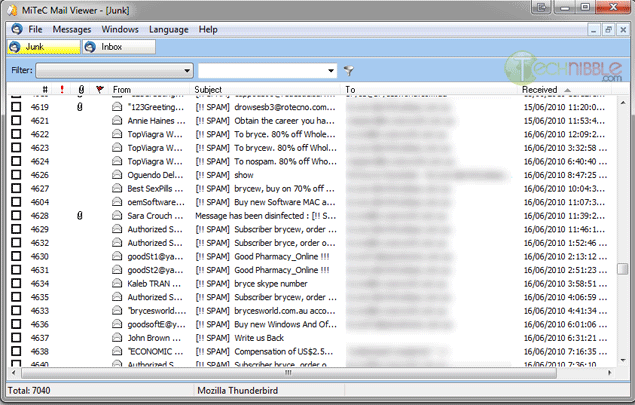
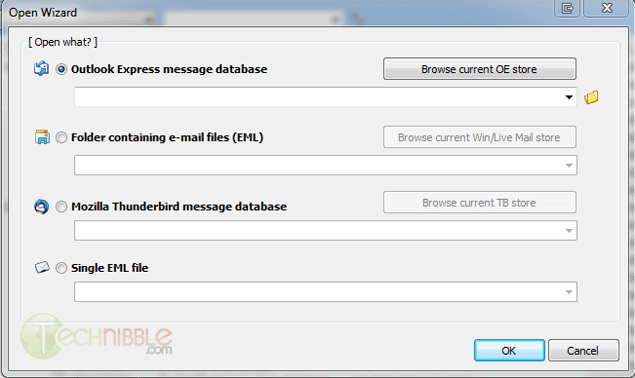
Mail Viewer is a free and portable application to view standalone Outlook Express, Windows Live Mail and Thunderbird databases. By standalone, I mean it will display a list of the emails contained in the databases without actually setting up the email client the file belongs to. Mail Viewer allows you to view most of what you can in an ordinary email client such as view single emails, attachments and HTML preview. It also features powerful search and filtering capabilities to find specific emails inside the databases.

I recently used this application when my father needed to reference an old email from 2007. We always keep backups but it was around this time he migrated from Outlook Express to Mozilla Thunderbird, so I wasn’t sure which database this email from 2007 was in. I also had backups of the backups from various periods so I had to look in many different backup versions to find it. While it isnt too hard to setup the old database in the new application, it would have been quite time consuming to search through all of the old backup versions. Mail Viewer was perfect for this situation and is definitely worth adding to your toolkit.

Mail Viewer is free for both private and commercial users.

Screenshots:


Downloads:

Download from Official Site – 1.37mb

More Information

© Technibble – A Resource for Computer Technicians to start or improve their Computer Business
To get started with your own computer business, check out our Computer Business Kit.
image

Read more: