Ottawa Computer Services

Ottawa Computer Services. Taleam Systems offers desktop and laptop repair in Ottawa, Ontario at affordable rate only $30 per hour.

We can fix your computer if you are having Windows problems, Virus issues, hardware problems, network issues or printer problems.

Taleam Systems offers support for Acer, Dell, HP, IBM, Lenovo, Sony and Read More…

Read more:

Instant Virus Removal Support From FixSmith !!!


The possible reasons for PC problems are multiple. Viruses Infections, malware or spyware are typical problems that are experienced with computers. These infections are seen as a a lack of files unexpectedly, programs which are acting randomly, and also the computer responding slowly to commands. If Skilled technicians have found a few of the symptoms  on your PC, then repair really should not difficult. It does not take too much time.

<p class=”MsoNorRead More…

Read more:

Instant Virus Removal Support From FixSmith !!!


The possible reasons for PC problems are multiple. Viruses Infections, malware or spyware are typical problems that are experienced with computers. These infections are seen as a a lack of files unexpectedly, programs which are acting randomly, and also the computer responding slowly to commands. If Skilled technicians have found a few of the symptoms  on your PC, then repair really should not difficult. It does not take too much time.

<p class=”MsoNorRead More…

Read more:

YUMI – Install Multiple Operating Systems to a Single Bootable USB Drive

Authors: Bryce Whitty

YUMI (which stands for Your Universal Multiboot Installer) is a tool that allows you to install multiple operating systems to a single bootable flash drive. YUMI will automatically create a menu allowing you to choose which operating system you wish to boot into as the system starts. We have featured mutliboot creators in the past but I really like YUMI because it is just so easy to use.

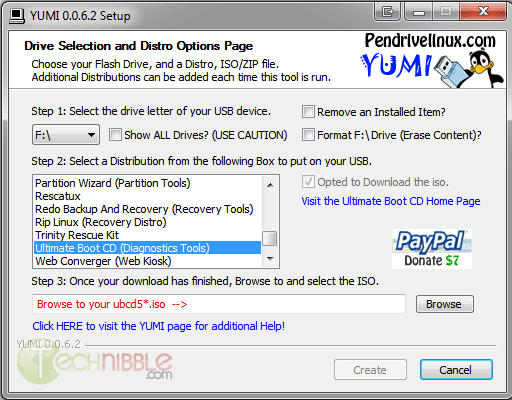
To use YUMI, you simply choose the drive letter of the thumb drive you wish to use, select a distribution you wish to install from the list, tick the “Download the ISO” if you havent done so already, wait for the ISO to download, navigate to the download location of the ISO on your hard drive and press Create. Thats it. To add an additional ISO to the USB drive, just do the steps above again.

Even though the boot menu and the ISOs installed on the USB drive are Linux based, you can still use the same drive to carry your Windows based repair tools since it formats the thumb drive to FAT32 – which is readable by Windows. However, I suggest you don’t move any of the files YUMI placed since it may upset the software installed on it.

Another reason I like this software, especially for us Computer Technicians is the selection of ISOs you can install on it. As you would expect, the usual suspects like Linux Ubuntu, Mint and Puppy are included. However, YUMI features a lot of distributions specifically intended for computer repair such as:

  • Acronis Antimalware CD
  • AVG Rescue CD
  • AVIRA AntiVir Rescue CD
  • BitDefender Rescue Disk
  • Dr. Web Live CD
  • F-secure Rescue CD
  • Kaspersky Rescue Disk
  • Panda SafeCD
  • Blackbox (penetration testing)
  • BackTrack5 Blackbox (penetration testing)
  • Clonezilla (Backup + Clone Tool)
  • DBAN (Hard Drive Nuker)
  • Deft 7 (Forensics)
  • DRBL (Diskless Remote Boot in Linux)
  • EASEUS Disk Copy (Disk Cloning Tool)
  • GParted (Partition Tool)
  • HDT (Hardware Detection Tool)
  • Matriux (penetration testing)
  • Offline NT Password & Registry Editor
  • Ophcrack XP (Password Finder)
  • Ophcrack Vista/7 (Password Finder)
  • Parted Magic (Partition Tool)
  • PING (Partimg Is Not Ghost)
  • Partition Wizard (Partition Tool)
  • Redo Backup and Recover (Recovery Tool)
  • RIP Linux (Recovery Distro)
  • Trinity Rescue Kit
  • Hirens Boot CD
  • Kon-Boot Floppy Image
  • Windows Vista/7/8 Installer

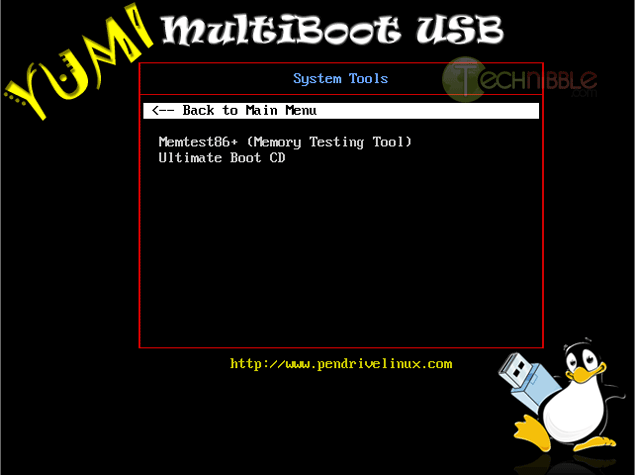
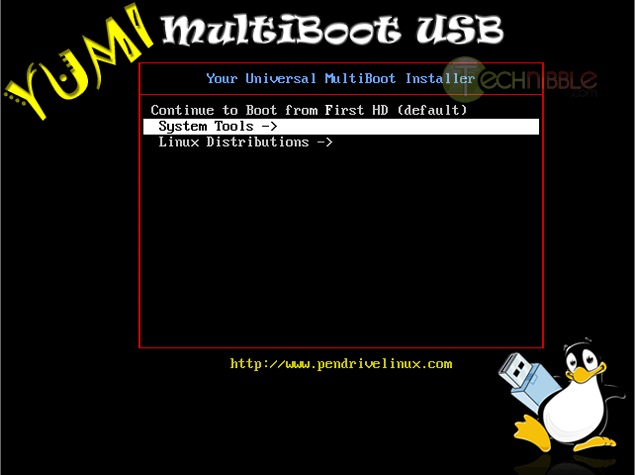
If you happen to install multiple operating systems to your USB key, YUMI will categorize them as you can see in the screenshots.

Screenshots

YUMI - Multiboot USB Interface

YUMI - Multiboot USB Bootloader

YUMI - Multiboot USB Bootloader


Downloads:

Download from Official Site – 948kb

More Information

© Technibble – A Resource for Computer Technicians to start or improve their Computer Business
To get started with your own computer business, check out our Computer Business Kit.


image

Read more:

How to Increase Your Business Clients to Improve Your Profit Margins

Authors: Guest Writer

Guest Post by Richard Muscat Azzopardi
Taking the step from being a computer technician fixing home PCs to someone running a business which thrives off planning, building, maintaining and repairing other businesses’ IT solutions is one which might seem daunting to some. However by doing so you can increase profit margins considerably and probably reduce your general stress levels in the process too.

Before you ponder on changing your business model, however I would advise taking a long hard look at the business you’re running at the moment. Have you ever thought of whether it is really profitable? If you were paying yourself (and your better half, who’s probably putting in quite a bit of hours with you) an honest wage would you still be running a profitable business? When was the last time you ran this exercise?

As part of this check I would also recommend analyzing the different jobs you’re doing. Which of them are profitable and which of them are you doing as a “service” to your clients? For example some home clients expect you to do the installation work for free when you sell them hardware. Even if you are charging them, there is a limit to what you can charge unless you want them to run to the Internet to look for advice and try it out themselves.

Business customers are very different. First of all they see IT as an essential tool. There might have been a time when a farmer would try and fix his own truck, but nowadays they all take them to mechanics. The same goes for computers – businesses see them as something they can’t live without (because they really can’t!) and therefore tend to do whatever is needed to keep their systems running smoothly. A home computer not working for a day means you can’t check Facebook for 24 hours. A business computer not working for a day implies loss of productivity and therefore precious income.

Because IT is so important to businesses, they tend to generate a significant amount of work. A successful business must take its maintenance seriously, its upgrades with enough foresight and its backups with the precision of a Swiss watch! In addition to generating more work per computer, when you’re hooked up with a business client, you usually have more PCs to work on too. If you take a look at the turnover generated by a single (small) business client over the course of a year you can probably equate it to four to five families’ worth of work.

It is not all fun and games, because expectations on your level of commitment increase too, but this is mainly the reason you can charge higher rates. It is also harder to win the client over because there is more competition and a higher chance that they are already in some form of a relationship with another supplier/technician.

If you have decided that it is worth exploring as an idea, you now need to find ways to get the word out there and start attracting business clients. I have a few suggestions that you might want to try out.

1) Tap your existing client base

Your existing clients are probably an ideal first step in trying to get new business. Statistically, most of them work at a small business, so if you approached them there is a good chance of them either being the decision maker at office or at least knowing who is. Don’t push yourself too hard with people who are generating your bread and butter income though, because you don’t want to scare them off from giving you their custom. You can either drop a hint when you’re at their place or else insert a new email signature which says you service businesses too. It might also be worth your while to offer a small bounty to friends and long-term clients who can introduce you to a new business client.

2) Approach the local business community

Targeting local businesses with direct mail, the local yellow pages or advertising in a local paper would be a great method to start offering services. Your major investment here could be your time. Offer a free audit of their systems – that way you can give them something of value. If you do your job well enough at this stage, you’re the one they’re going to want to implement the recommendations to fix the issues that arise.

3) Mixing at business events

Scour the papers and online notice boards for business breakfasts or any other business meetings organised in your community. These are a great source of new contacts and people are expecting you to discuss business opportunities. If there are talks, then try and get a speaking gig – even if you offer your time for free. Use this time to outline the importance of having a solid IT infrastructure. Businesses love having a thought leader consulting them – it inflates their ego.

4) Buy a set of golf clubs

Or join the local chapter of the Rotary Club. Every community has its own version of a place for businessmen to hang out informally. Whereas these might seem to be a place to relax, a lot of business wheeling and dealing goes on in between holes on the local golf course. You will have to take it more easily here. People are officially there to enjoy themselves and relax so you have to observe others and respect the etiquette in place.

5) Online

Building a good presence online is a crucial part of achieving your goal. I have left it to last for one simple reason – no matter which of the methods above you decide to go with, this should have to happen in tandem. Create a personal LinkedIn profile and build it up as much as possible. Get recommendations from former colleagues and current clients and keep the account active on a daily basis. Create Google+ and Facebook pages as a local business and post items to them regularly. Ideally you shouldn’t broadcast, but also interact with people who’ve liked your pages. Offer free advice online to business customers – and make these posts public so you can show your expertise.

Whichever of these tickles your fancy, I would suggest not trying out more than one or two of them to start off. Ease yourself into the market and there is far less chance of being overwhelmed. Slow and steady wins the race.

This is a guest post written by Richard Muscat Azzopardi on behalf of IT Channel Insight, a site related to managed IT services. Richard draws on his experience from over 12 years in the publishing industry to bring you top quality content that works. He now writes blog posts, white papers and e-books for the IT industry with the same passion that drove him to create his country’s most popular publication.

© Technibble – A Resource for Computer Technicians to start or improve their Computer Business
To get started with your own computer business, check out our Computer Business Kit.
image

Read more:

How to Effectively Charge Customers for Travel Time

Authors: Derrick Wlodarz

Tackling any topic related to rates is likely one of the most debatable areas to touch with a ten foot pole. Technicians are stoutly protective of their pricing structures when the discussion comes up. However, I’m admittedly adventurous in this realm and believe that the more open we are with effective ways to address travel costs, the better we can serve our customers in settings fees that are appropriate for both sides. I took a chance to address proper self-worth valuation when it comes to pricing a little while back, but let’s see if we can tackle travel costs this time around.

My goal here is not to say that my methodology is necessarily better; it works for my computer repair company FireLogic and I’m open to sharing it fully with fellow techs. The overarching goal with this article is to merely establish a friendly debate on all of the available methods for charging on travel, and weighing the pros/cons of each. There is no single method or rate that fits all technicians. We’re all disparate in our own ways: serving different communities, working with different customers, and operating within distinct socioeconomic regions.

The Technibble forums are generally host to some interesting discussion on travel fees and how to determine them. A few particular threads hosted some great insight like this one, a thread related to call out charges, and this discussion on how to charge for visits that are out of area. I’m going to admittedly pull a mixture of ideas from various forum postings below to give people an idea of what various techs have concocted to meet this growing need. Let’s take a look at the different ways you can charge your own customers for travel time.

The flat hourly rate

I’ll cover this one first since this is how FireLogic handles travel costs. I like this model because it’s simple for a customer to understand and doesn’t require any extensive tracking/recording besides time. My view is that if someone is willing to pay for us to travel out to visit them, a flat hourly travel rate properly compensates the tech that needs to make the trip and covers gas expenses. Our travel rate is currently $20USD/hr (about 1/4 of what our hourly onsite rate is) and has proven to be a happy medium for our customers and techs. We do not charge for return travel, as the notion goes that the next customer being visited will pick up the subsequent trip as their visit charge. Some forum goers admit to charging their full hourly rate for travel, which is understandable depending on your situation. Do your research before establishing anything, but for the Park Ridge and suburban Chicago area (USA) this system has been very successful for us with little customer pushback.

Enforcing minimum onsite service fees

This is an roundabout to charging outright travel fees or an hourly trip rate. In this method, you notify your customer that they will be paying, for example, a one hour minimum of service for the visit. More than a few techs on the forums prefer this approach as it keeps travel fees out of the customer’s sight, and also cuts back on excessive abuse of onsite labor for small tasks. From the consensus I could gather, it seems that rural techs tend to like this method as travel fees are frowned upon in such locales but customers take positively to this approach. I don’t think it would be a bad idea to use a hybrid approach of a travel rate with an onsite minimum. Again, your circumstances and competition’s methods will have a big bearing on your own attitude towards this model.

Staggered travel flat-rate fee

Yet another way to charge for travel is to create a graduated, or staggered, trip charge schedule that is based upon the number of miles from your home base to the customer location. The benefit of this model is that it directly segregates shorter trips from longer ones, and gives the customer an easy way to estimate their final total. However, the downside is that if traffic catches a technician, even a short 4 mile trip in an urban area could turn out to take just as much, if not more time, than a 10 mile journey in the countryside. I personally frown upon this model since I service the suburban Park Ridge region of Chicago, and traffic can be dicey depending on time of day and the direction of a customer location. For rural techs, this may be more appealing.

Charging “by the mile” based on a standard rate

A similar method as the staggered model above, but this one ties exact mileage or distance traveled to a standardized rate “per mile” or “per kilometer.” For the United States, I have heard of many techs tie their rate to correlate directly with the mileage rate used by the federal government. As with the staggered method, I don’t believe it fully takes into account the time spent traveling to a customer in busy, traffic-drenched areas. But for techs that want a simpler, streamlined way to present their travel rates to customers, this is about as clean cut as it gets. Tying your travel rate to the same as the government uses cuts down on arguments from clients because you can merely point them to the higher authority for why you charge what you do.

Utilizing different onsite vs offsite service rates

My company uses this notion for how our prices are set. For our case, it’s not directly to take into account travel costs. We differentiate hourly rates moreso because of the simple fact that when I am onsite, I am dedicated solely to that single customer. I cannot multi-task in any way like one can do in-shop or from their home office. For this reason, a different price is justified. But some techs claim that merely forgoing a separate travel fee and charging an inflated 20-30% of their regular rate is effective. The benefit is that you can mask your travel costs to the customer. The downside is that such a massive difference in rate may sway more customers than you wish to use your services at the “discounted” rate and stick to remote support or the like. Good or bad, it’s up to you to decide how this may work out.

Whichever method you ultimately decide to use, remember that doing some competitive analysis is always key to a rate structure that customers will be open to. You don’t want to blindly change your travel fee methodology without sniffing around to see what your local techs are charging, and how they are structuring their fees. Systems that may work well for rural areas are not always suitable for urban areas as I described above. Do your homework, reach out to some customers for their feelings, and make an informed decision. How you publicly account for travel expenses using any of the methods above may be just as important as what amount you charge a customer.

Feel free to post your own ideas or comments on what you think is the best way to charge for travel. What works? What doesn’t? Let us know!

© Technibble – A Resource for Computer Technicians to start or improve their Computer Business
To get started with your own computer business, check out our Computer Business Kit.
image

Read more:

Episode 59 – ScreenConnect Part 2

Today we are going to conclude our discussion with a professional from a company offering a self-hosted remote support solution and find out how we can customize this remote support software to help our own businesses become more profitable.

TechPodcasts Promo Tag :10
Intro 1:18
Billboard :37

News and Comment segment 6:54
The US International Trade Commission ordered an import ban on Motorola Mobility products with Android May 18th.

VIPRE Antivirus is offering a Free 30 Day Trial Download of VIPRE Antivirus Business Software.

The Force Field Episode 58 featured a commentary on a ZDNet article called OnForce: Improving economy might not be helping IT industry. After the episode was released, the author added a direct link to the original report that was cited as the source of the data presented in the article. The assessment of the report in The Force Field show commentary was correct.

Commercial Break 2:00
The Computer Business Kit

Intro to Topic 1:37
Today we’re going to continue our discussion with Jeff Bishop of Elsinore Technologies and learn more about a remote support system called ScreenConnect. We’ll discuss the difference between the tools used for remote support and managed services, the advantages of using self hosted support software over a hosted, subscription based service, and how customizing and branding a remote support tool can add a whole new dimension to the marketing and promotion of your IT business.

Interview with Jeff Bishop 25:07

Wrap up and Close :46

Comments, questions or suggestions? Send them in to comments@theforcefield.net or post them in The Force Field Forums. Feedback on this topic will be read by the host and included in future episodes of the show. Visit us at http://www.theforcefield.net!

©2012 Savoia Computer. All rights reserved.


Episode 59 – ScreenConnect Part 2

Today we are going to conclude our discussion with a professional from a company offering a self-hosted remote support solution and find out how we can customize this remote support software to help our own businesses become more profitable.

TechPodcasts Promo Tag :10
Intro 1:18
Billboard :37

News and Comment segment 6:54
The US International Trade Commission ordered an import ban on Motorola Mobility products with Android May 18th.

VIPRE Antivirus is offering a Free 30 Day Trial Download of VIPRE Antivirus Business Software.

The Force Field Episode 58 featured a commentary on a ZDNet article called OnForce: Improving economy might not be helping IT industry. After the episode was released, the author added a direct link to the original report that was cited as the source of the data presented in the article. The assessment of the report in The Force Field show commentary was correct.

Commercial Break 2:00
The Computer Business Kit

Intro to Topic 1:37
Today we’re going to continue our discussion with Jeff Bishop of Elsinore Technologies and learn more about a remote support system called ScreenConnect. We’ll discuss the difference between the tools used for remote support and managed services, the advantages of using self hosted support software over a hosted, subscription based service, and how customizing and branding a remote support tool can add a whole new dimension to the marketing and promotion of your IT business.

Interview with Jeff Bishop 25:07

Wrap up and Close :46

Comments, questions or suggestions? Send them in to comments@theforcefield.net or post them in The Force Field Forums. Feedback on this topic will be read by the host and included in future episodes of the show. Visit us at http://www.theforcefield.net!

©2012 Savoia Computer. All rights reserved.